PORTFOLIO STUDY SKILLS(UED 102)

Assalamualaikum and Hello to all my blogger reader.Salam UiTM Dihatiku
My name is Imran Danial Bin Mohd Azian.I am from Rawang,Selangor.I am 19 years old and a undergraduated at UiTM Cawangan Terengganu,Kampus Dungun.My Course is Diploma in Culinary Arts.i am very happy to be part of this big family UiTM.I hope i will success all of my subject with flying colours
The main reason i created this blog is to introduce you how my study skills at the university.This blog will be mark on my subject study skill(UED 102).I will show you all of my notes in every topic that i learned during my class that have been taught by my lecturer Puan Malissa Sahila Abdul Manap
CONTENT OF UED102
ITEMS:
Topic 1: Getting Ready to Learn
⦁ Learning Style Inventory
Topic 2: Goals Setting
⦁ Goal Statements –The Five Step Approach
Topic 3: Library & Campus Resources
⦁ Notes on Library Tour
Topic 4: Time Management & Organizational Skills
⦁ Fixed-Commitment Calendar
⦁ Job Task Analysis
⦁ Prioritized To-Do List
Topic 5: Memory, Learning & Improving Concentration
⦁ Memory Strategies
⦁ Organizational Strategies
⦁ Concentration Strategies
⦁ Concentration Chart
⦁ Reading Text
Topic 6: Taking Lecture Notes
⦁ Note-Taking Strategies
⦁ Note-taking Exercise using the Cornell Method
Topic 7: Academic Integrity & Performance
⦁ GPA Worksheet
⦁ Learning Style Inventory
Topic 2: Goals Setting
⦁ Goal Statements –The Five Step Approach
Topic 3: Library & Campus Resources
⦁ Notes on Library Tour
Topic 4: Time Management & Organizational Skills
⦁ Fixed-Commitment Calendar
⦁ Job Task Analysis
⦁ Prioritized To-Do List
Topic 5: Memory, Learning & Improving Concentration
⦁ Memory Strategies
⦁ Organizational Strategies
⦁ Concentration Strategies
⦁ Concentration Chart
⦁ Reading Text
Topic 6: Taking Lecture Notes
⦁ Note-Taking Strategies
⦁ Note-taking Exercise using the Cornell Method
Topic 7: Academic Integrity & Performance
⦁ GPA Worksheet
TOPIC 1
a)Getting Ready to Learn


CHARACTERISTICS OF SUCCESSFUL STUDENTS
1. Intellectually curious
In order to be a successful student, it is basically important for you to engage with your subject.
It is all depend on you to caring about your studies and your willingness to find something worthwhile studying in order to keep you on track during your studies. One of a good way to be a successful students is by observing others who are good at what they do, and then asking questions about anything and everything you don't understand. Asking questions to experts is a good way to learn. You can also find all the information through various types of information materials includes books, journals, and Internet.
2. Self-driven
University life is totally different from high school. In university, you are expected to manage your own workload, attendance, and assignment. If you start to miss classes or assignments, you will quickly find your grades slipping, or worse, you may even fail. It is essential for you to motivate yourself to prevent this from happening. Good students will push themselves to do the best they can in their assignments. To achieve good results, students must give their full commitment because commitment is a vital aspect of being self-driven
3. Good time management
Good time management is the process of organizing and planning how to divide your time between specific activities. Successful students should plan their schedule well in order to make sure they can attend all the classes and most important have enough time to finish their assignments.
4. Admitting you don't understand
It's fine to say that you don't know something, or that you don't understand certain topics during classes. By admitting it, the lecturers or other students around you can help by explaining the topic more clearly. If you aren't able to admit you don't know something, you won't be able to complete a good quality assignment.
5. Creative and original
A successful student always come up with new ideas or new ways of thinking to solve a problem. This successful student will give their own opinion on a topic or argument, even if it's different from what others have said. If you want to be a successful student, you must surround yourself with people who have a skill you want that can push you to improve.


Visual – Visual learners prefer to see or observe things, such as pictures, photographs, diagrams, demonstrations, displays, handouts, films, flip-chart, etc.
Auditory – Auditory learners prefer to learn by listening – to the spoken word (either themselves or from others) or from sounds and noises.
Kinesthetic (movement) – Kinesthetic learners prefer physical experience – touching, feeling, holding, doing, and practical hands-on experiences.


 |

TOPIC 2
GOAL SETTING
-Everyone has goal. Whether it is something major like have PHD by the age of 30 or losing 5 pounds within 2 weeks. Simple meaning of goal is something you would like to achieve. It gives you direction and keep motivates yourself to turn your vision of this future into reality. The process of setting goals helps you choose where you want to go in life. By knowing exactly what you want to achieve, you know where you have to concentrate your efforts.

Why Set Goals?
Top-level athletes, successful business people and achievers in all fields all set goals. Setting goals gives you long-term vision and short-term motivation. It focuses your acquisition of knowledge, and helps you to organize your time and your resources so that you can make the most of your life.
By setting sharp, clearly defined goals, you can measure and take pride in the achievement of those goals, and you'll see forward progress in what might previously have seemed a long pointless grind. You will also raise your self-confidence, as you recognize your own ability and competence in achieving the goals that you've set.
Top-level athletes, successful business people and achievers in all fields all set goals. Setting goals gives you long-term vision and short-term motivation. It focuses your acquisition of knowledge, and helps you to organize your time and your resources so that you can make the most of your life.
By setting sharp, clearly defined goals, you can measure and take pride in the achievement of those goals, and you'll see forward progress in what might previously have seemed a long pointless grind. You will also raise your self-confidence, as you recognize your own ability and competence in achieving the goals that you've set.
Most importantly, the goals you set must have some important characteristics:
-Goals should be self-chosen
-Goals should be moderately challenging
-Goals should be realistic
-Goals should be measurable
-Goals should be specific
-Goals should be finite
-Goals should be positive
MY GOAL STATEMENT
-I Want to get dean's list every semester CGPA 3.5 above
YOUR REWARD
-I Want to go vacations with my friends and my family members
MILESTONES
-Need to reduce playing smart phone to achieve flying colours results
MOTIVATIONAL QOUTE
-' EDUCATION IS PASSPORT TO FUTURE '
1.Goal Should Be Self Chosen
YOUR REWARD
-I Want to go vacations with my friends and my family members
MILESTONES
-Need to reduce playing smart phone to achieve flying colours results
MOTIVATIONAL QOUTE
-' EDUCATION IS PASSPORT TO FUTURE '
1.Goal Should Be Self Chosen
- If you want to be a successfull people, you must set your goal. You must decide what you want to achieve in life.If you set your own goals,you will feel be more motivated to achieve them.Always think that you are the one that wants to achieve your own goals.
2.Goals Should Be Moderately Challenging.
- You must consider what you have done in past to set goals and make it moderately challenging.Goals always can be revised.You actually can achieve more than you originally set out to accomplish.
3.Goals Should Be Realistic
- The goal that you set must be realistic. You also must think first about your goals whether it is attainable or not.But, if you want to work hard on certain subject,it is not impossible to get excellent result in exam.To set realistic goals, you must carefully evaluate your chances to achieve your goal later.
4.Goals Should Be Measurable.
- Goal should be measureable based on your effort. Without a good effort, you cannot determine whether you can achieve that goal or not.A goal must be measurable.Only you can determine whether you can reach it or not.It would be much easier to measure your success if you had aimed for such as grade A or B in each subject. Work hard and study smart to make sure you can achieve your goal.
5.Goals Should Be Specific
- If your goals more specific ,it will be easier to achieve them and you will be more motivated.Such as you want to get A in Calculus .That was a specific goals.But if you said you just want to get good grade in Calculus that is not specific goals.So,make sure your goals more specific.
6.Goals Should Be Finite/Limits/Bounds
- Goals must have a time frame or due date.For example if you have assignment due to Saturday,you need to done it by Saturday too. If you finish your work on time then it will be easier for to prepare next assignment ot task.In your goals, it is important to set a deadlines.
7.Goals Should Be Positive
- Negative goals statements can make you can’t really be successful because they aren’t motivating. You must motivate yourself and most important you must trained yourself to be positive. If you have positive mind and attitude, the goal would be easier to achieve.
FIVE STEP APPROACH TO SETTING GOALS.
STEP 1 : TENTATIVE GOAL STATEMENT
Example: I want at least to get B in Hospitality and Tourism
STEP 2: LIST OF OBSTACLES
Example : I have a sight problem , and I struggle while taking notes.
STEP 3 : LIST OF RESOURCES
Example : I’ll rewrite my notes after class.
STEP 4 : REVISED GOAL STATEMENT
Example: I’ll try to get B in Integrated of Language
STEP 5: POLISHED GOAL STATEMENT
Example : I will achieve a A in Fundamentals of Islam in this semester

 TOPIC 4:TIME MANAGEMENT
Time Management
-it was defined by the ability for student or someone use their time,energy or resources their time effective with do a schedule for reference to them on everytime for what they must to do.
Why Time is so Important?
-time is very important in our lives and plays a significant role. Our whole life revolves around time. We should respect the time and also understand the value of time because the time gone is never going to come back. It's better to follow and respect time instead of regretting afterward.
FIVE STRATEGIES TO DEVELOP A SUCCESSFUL SYSTEM OF STUDY
TOPIC 4:TIME MANAGEMENT
Time Management
-it was defined by the ability for student or someone use their time,energy or resources their time effective with do a schedule for reference to them on everytime for what they must to do.
Why Time is so Important?
-time is very important in our lives and plays a significant role. Our whole life revolves around time. We should respect the time and also understand the value of time because the time gone is never going to come back. It's better to follow and respect time instead of regretting afterward.
FIVE STRATEGIES TO DEVELOP A SUCCESSFUL SYSTEM OF STUDY
⦁ Use a weekly schedule
⦁ Use a daily planner
⦁ Use a semester calendar
⦁ Balance academic with social and personal demands
⦁ Avoid procrastination
 JADUAL INTERIM JAN 2020


 Fixed-Commitment Calendar
 Job Task Analysis
 Prioritized Task List

 TOPIC 5:MEMORY,LEARNING & IMPROVING CONCENTRATION

 MEMORY STRATEGIES
Memory strategy is very important because it will help students in their encoding, storing and retrieving the information (help to remember and recall).
3 Different Type of Memory
FIVE STEP APPROACH TO SETTING GOALS.
STEP 1 : TENTATIVE GOAL STATEMENT
Example: I want at least to get B in Hospitality and Tourism
STEP 2: LIST OF OBSTACLES
Example : I have a sight problem , and I struggle while taking notes.
STEP 3 : LIST OF RESOURCES
Example : I’ll rewrite my notes after class.
STEP 4 : REVISED GOAL STATEMENT
Example: I’ll try to get B in Integrated of Language
STEP 5: POLISHED GOAL STATEMENT
Example : I will achieve a A in Fundamentals of Islam in this semester
STEP 1 : TENTATIVE GOAL STATEMENT
Example: I want at least to get B in Hospitality and Tourism
STEP 2: LIST OF OBSTACLES
Example : I have a sight problem , and I struggle while taking notes.
STEP 3 : LIST OF RESOURCES
Example : I’ll rewrite my notes after class.
STEP 4 : REVISED GOAL STATEMENT
Example: I’ll try to get B in Integrated of Language
STEP 5: POLISHED GOAL STATEMENT
Example : I will achieve a A in Fundamentals of Islam in this semester
TOPIC 4:TIME MANAGEMENT
Time Management
-it was defined by the ability for student or someone use their time,energy or resources their time effective with do a schedule for reference to them on everytime for what they must to do.
Why Time is so Important?
-time is very important in our lives and plays a significant role. Our whole life revolves around time. We should respect the time and also understand the value of time because the time gone is never going to come back. It's better to follow and respect time instead of regretting afterward.
FIVE STRATEGIES TO DEVELOP A SUCCESSFUL SYSTEM OF STUDY ⦁ Use a weekly schedule
⦁ Use a daily planner
⦁ Use a semester calendar
⦁ Balance academic with social and personal demands
⦁ Avoid procrastination
JADUAL INTERIM JAN 2020
Fixed-Commitment Calendar

Job Task Analysis

Prioritized Task List

TOPIC 5:MEMORY,LEARNING & IMPROVING CONCENTRATION
MEMORY STRATEGIES
Memory strategy is very important because it will help students in their encoding, storing and retrieving the information (help to remember and recall).
Memory strategy is very important because it will help students in their encoding, storing and retrieving the information (help to remember and recall).
3 Different Type of Memory
Sensory Memory (SM) - Remember something by using memory
Short-term Memory (STM) - Remember something just for 30sec to 24 hours
Long-term Memory (LTM) - Remember something for long time


Ways To Improve Our Memory
-Don't skip the physical exercise
-Make time for friends
-Keep stress in check
-Have a laugh
-Eat a brain-Boosting diet
-Identify and treat health problems
-Take practical steps to support learning and memory
Concentration
The meaning of concentration is focusing your attention on what you are doing
Strategies to Improve Our Memory
- Be an active learner or listener in class. Put your hands up if you do not understand.
- Be focus in class. Ignore anythings that will disturb you if you not to want dismiss any important information.
- Use motivational goals to keep you focus and remain you what you want to archive in all semester or you want to repeat your sem?
Concentration Chart

Causes of Poor Concentration
1.Lack of attention
2.Lack of interest
3.Lack of motivation
4.Distraction from others
5.Uncomfortable environment
6.Physiological matters-illness,tiredness
7.Phychological matters-personal problems,worries,anxieties
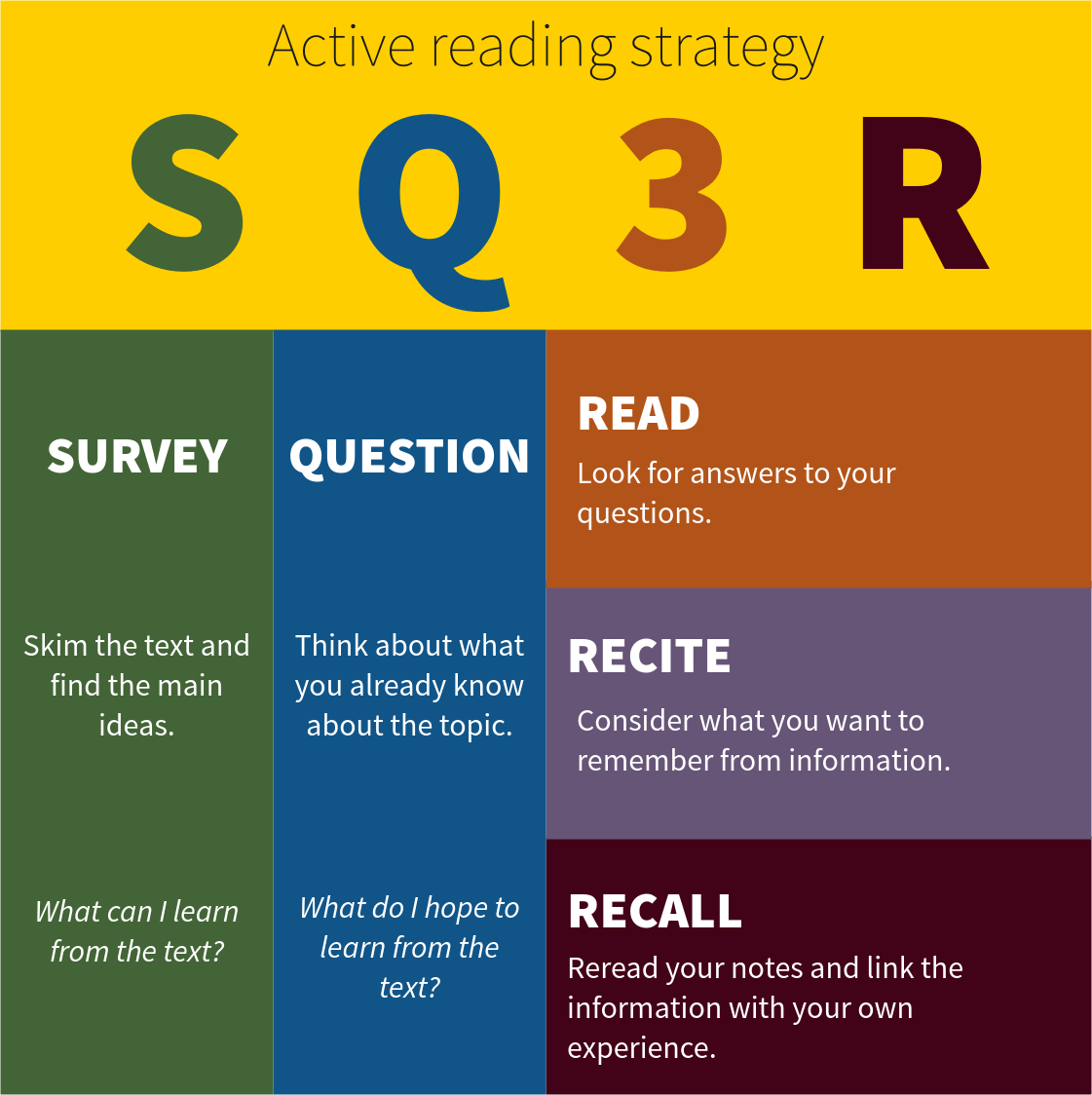
Reading Text
SQ3R:SURVEY-QUESTION-READ-RECITE-REVIEW
TOPIC 6:TAKING LECTURE NOTES
WHY TAKE LECTURE NOTES
⦁ Promotes active listening
⦁ Provides an accurate record of information.
⦁ Provides an opportunity to interpret, condense and organize information.
⦁ Provides an opportunity for repetition of the material.
⦁ Essentially, Learning and practicing effective strategies for how to take lecture notes will help you become a more successful student.
HOW TO TAKE LECTURE NOTES
Prepare Before Taking Notes
The best way to prepare your note-taking activity is to READ the text assignment Before Class. By reading the text assignment before the lecture you, it will allow you to:
⦁ Build up some background about the topic
⦁ Have some idea what the lecture is about
⦁ Identify main ideas of the lecture and organize your notes easier
⦁ Be familiar with key terms and names related to the topic
As you walk into lecture classroom, get ready to take notes. You must sitting in front of the classroom, allows you to see and hear better. You will probably find that other interested and motivated students also tend to sit in the first few rows of the class. While waiting for class to begin, don’t forget to review notes that you took during the last class meeting.
Become and Active Listener
Strategies for improving listening skills
⦁ Read the text assignment before the lecture to build background on the topic
⦁ Review you last set of notes before the lecture begins
⦁ Sit in the lecturer’s line of vision
⦁ Decide what you want to listen
⦁ Focus your attention physically by sitting up and making eye contact with the speaker
⦁ Focus your attention mentally by eliminating or avoiding distractions
⦁ Listen with an open mind, setting aside your own biased
⦁ Control your emotional responses
⦁ Listen for the main points and related details and take notes
⦁ Ask and answer questions
⦁ Monitor your listening. Check with lecturer or a classmate (at the end of the lecture) if you’re unsure of some of the information
Effective Note Taking System
Taking note is writing down ideas and read it with our own word. One of the effective note taking system is The Cornell Note-Taking system.
The Cornell Note-Taking System - has an excellent format for setting up your note page. Use an 8.5-by-11 inch notebook. It has a recall/cue column and a summary column at the end.
The Cornell Notes Method
The Cornell Method
PLAGIARISM
"Plagiarism: presenting other's work without adequate acknowledgement of its source, as though it were one’s own. Plagiarism is a form of fraud. We all stand on the shoulders of others, and we must give credit to the creators of the works that we incorporate into products that we call our own.
Some examples of plagiarism:
⦁ A sequence of words incorporated without quotation marks
⦁ An unacknowledged passage paraphrased from another's work
WHAT TO INCLUDE IN YOUR NOTES
Headings
Always note all headings – The main points – That are made during a lecture.
Details
Listen for all details
Here, there are some detail that you may want to focus on:
⦁ Any facts or explanations that expand or explain the main points that are mentioned.
⦁ Definitions word for word especially if your lecturer repeats them several times.
⦁ Enumerations or list of things that are discussed
⦁ Examples – you don’t need to note all of the details for each example, but you need to know to which general topic (heading) each example relates.
⦁ Anything that is repeated and spelled out
⦁ Anything that is written on the whiteboard or on a PowerPoint slide
⦁ Drawings,Charts,or Problems that are written on the board
Reviewing Notes
Note is the most important thing when you are studying on any level of education.Here I will discuss that there are three ways to review your notes.
Recite from the headings
You can review your notes by using the headings or topics to prompt your memory.After you reciting the note aloud,cover the information under each heading and try to recall of the points related to the topics.Then make sure your note not missing any information.
Recite from the recall questions
Use the recall questions,when you think you know the information in your notes.This can test your memory of the supporting details and also the main points.By using this method,you learn the material in an isolated way.You learn specific answers to specific questions.
Talk about the information with others
Another way to study the information in your notes is simply to talk about it.Create the information in your own words and explaining it to others.This is the most excellent way to move it into long term memory.Stick together with your note –taking friends or a study group to review your notes.You can turns dicussing the information,predicting additional test questions and quizzing each other on the information.
TOPIC 7: ACADEMIC INTEGRITY & PERFORMANCE
CALCULATING GRADE POINT AVERAGE
The final examination results and assessments at the end of every semester are assigned a Grade Point Average (GPA) and a Cumulative Grade Point Average (CGPA) which represent a student’s academic achievement.
A Grade Point Average (GPA) refers to the calculated average of the letter grades a student earns in each semester following a 0 to 4.0 scale.
GPA Calculation


Every semester, students receive a GPA based on the grades they earned in all their courses during that semester. The formula used for the calculations of the Grade Point Average (GPA) is as follows:
GPA = The total credit values registered and attempted in the assessment of a semester
------------------------------------------------------------------------------------------------
The total credit units acquired in the same semester
To find GPA weighted by credit hours, follow these steps:
Cumulative Grade Point Average (CGPA) refers to the overall GPA, which includes dividing the number of quality points earned in all courses attempted by the total credit hours in all attempted courses.
CGPA = The total credit values registered and attempted in the assessment of all semesters
------------------------------------------------------------------------------------------------
The total credit units acquired in all semesters
 |

|
Ways To Improve Our Memory
Strategies to Improve Our Memory
- Be an active learner or listener in class. Put your hands up if you do not understand.
- Be focus in class. Ignore anythings that will disturb you if you not to want dismiss any important information.
- Use motivational goals to keep you focus and remain you what you want to archive in all semester or you want to repeat your sem?
Concentration Chart
Causes of Poor Concentration
1.Lack of attention
2.Lack of interest
3.Lack of motivation
4.Distraction from others
5.Uncomfortable environment
6.Physiological matters-illness,tiredness
7.Phychological matters-personal problems,worries,anxieties
Reading Text
SQ3R:SURVEY-QUESTION-READ-RECITE-REVIEW
TOPIC 6:TAKING LECTURE NOTES
WHY TAKE LECTURE NOTES
⦁ Promotes active listening
⦁ Provides an accurate record of information.
⦁ Provides an opportunity to interpret, condense and organize information.
⦁ Provides an opportunity for repetition of the material.
⦁ Essentially, Learning and practicing effective strategies for how to take lecture notes will help you become a more successful student.
HOW TO TAKE LECTURE NOTES
Prepare Before Taking Notes
The best way to prepare your note-taking activity is to READ the text assignment Before Class. By reading the text assignment before the lecture you, it will allow you to:
⦁ Build up some background about the topic
⦁ Have some idea what the lecture is about
⦁ Identify main ideas of the lecture and organize your notes easier
⦁ Be familiar with key terms and names related to the topic
As you walk into lecture classroom, get ready to take notes. You must sitting in front of the classroom, allows you to see and hear better. You will probably find that other interested and motivated students also tend to sit in the first few rows of the class. While waiting for class to begin, don’t forget to review notes that you took during the last class meeting.
Become and Active Listener
Strategies for improving listening skills
⦁ Read the text assignment before the lecture to build background on the topic
⦁ Review you last set of notes before the lecture begins
⦁ Sit in the lecturer’s line of vision
⦁ Decide what you want to listen
⦁ Focus your attention physically by sitting up and making eye contact with the speaker
⦁ Focus your attention mentally by eliminating or avoiding distractions
⦁ Listen with an open mind, setting aside your own biased
⦁ Control your emotional responses
⦁ Listen for the main points and related details and take notes
⦁ Ask and answer questions
⦁ Monitor your listening. Check with lecturer or a classmate (at the end of the lecture) if you’re unsure of some of the information
Effective Note Taking System
Taking note is writing down ideas and read it with our own word. One of the effective note taking system is The Cornell Note-Taking system.
The Cornell Note-Taking System - has an excellent format for setting up your note page. Use an 8.5-by-11 inch notebook. It has a recall/cue column and a summary column at the end.
The Cornell Notes Method
The Cornell Method


PLAGIARISM
"Plagiarism: presenting other's work without adequate acknowledgement of its source, as though it were one’s own. Plagiarism is a form of fraud. We all stand on the shoulders of others, and we must give credit to the creators of the works that we incorporate into products that we call our own.
Some examples of plagiarism:
⦁ A sequence of words incorporated without quotation marks
⦁ An unacknowledged passage paraphrased from another's work
WHAT TO INCLUDE IN YOUR NOTES
Headings
Always note all headings – The main points – That are made during a lecture.
Details
Listen for all details
Here, there are some detail that you may want to focus on:
⦁ Any facts or explanations that expand or explain the main points that are mentioned.
⦁ Definitions word for word especially if your lecturer repeats them several times.
⦁ Enumerations or list of things that are discussed
⦁ Examples – you don’t need to note all of the details for each example, but you need to know to which general topic (heading) each example relates.
⦁ Anything that is repeated and spelled out
⦁ Anything that is written on the whiteboard or on a PowerPoint slide
⦁ Drawings,Charts,or Problems that are written on the board
Reviewing Notes
Note is the most important thing when you are studying on any level of education.Here I will discuss that there are three ways to review your notes.
Recite from the headings
You can review your notes by using the headings or topics to prompt your memory.After you reciting the note aloud,cover the information under each heading and try to recall of the points related to the topics.Then make sure your note not missing any information.
Recite from the recall questions
Use the recall questions,when you think you know the information in your notes.This can test your memory of the supporting details and also the main points.By using this method,you learn the material in an isolated way.You learn specific answers to specific questions.
Talk about the information with others
Another way to study the information in your notes is simply to talk about it.Create the information in your own words and explaining it to others.This is the most excellent way to move it into long term memory.Stick together with your note –taking friends or a study group to review your notes.You can turns dicussing the information,predicting additional test questions and quizzing each other on the information.
TOPIC 7: ACADEMIC INTEGRITY & PERFORMANCE
CALCULATING GRADE POINT AVERAGE
The final examination results and assessments at the end of every semester are assigned a Grade Point Average (GPA) and a Cumulative Grade Point Average (CGPA) which represent a student’s academic achievement.
A Grade Point Average (GPA) refers to the calculated average of the letter grades a student earns in each semester following a 0 to 4.0 scale.
GPA Calculation

Every semester, students receive a GPA based on the grades they earned in all their courses during that semester. The formula used for the calculations of the Grade Point Average (GPA) is as follows:
GPA = The total credit values registered and attempted in the assessment of a semester
------------------------------------------------------------------------------------------------
The total credit units acquired in the same semester
To find GPA weighted by credit hours, follow these steps:
Cumulative Grade Point Average (CGPA) refers to the overall GPA, which includes dividing the number of quality points earned in all courses attempted by the total credit hours in all attempted courses.
CGPA = The total credit values registered and attempted in the assessment of all semesters
------------------------------------------------------------------------------------------------
The total credit units acquired in all semesters


Comments
Post a Comment